Secoisolariciresinol Diglucoside (SDG)
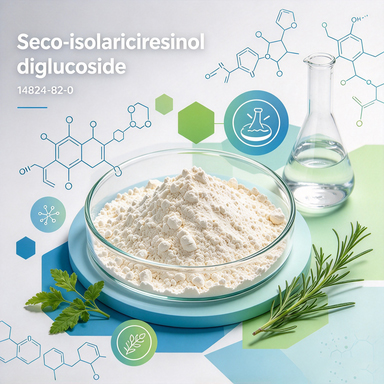
Product Overview
Secoisolariciresinol Diglucoside (SDG) is a plant lignan that researchers commonly associate with flaxseed (Linum usitatissimum). As an important member of the lignan family, SDG attracts interest from researchers, nutraceutical developers, and botanical ingredient manufacturers.
In particular, researchers study SDG for its chemical properties, antioxidant activity, metabolism, and potential applications in nutritional ingredient development. Therefore, this compound offers a relevant option for laboratories and businesses that explore plant-derived lignans and specialized botanical ingredients.
Key Product Information
-
Product Name: Secoisolariciresinol Diglucoside
-
Abbreviation: SDG
-
CAS Number: 148244-82-0
-
Compound Class: Plant lignan
-
Natural Source Association: Flaxseed
-
Research Areas: Plant chemistry, lignan analysis, antioxidant research, and nutraceutical ingredient development
-
Product Specifications: Please contact our team for the available grade, purity, analytical data, and packaging options.
Applications of Secoisolariciresinol Diglucoside
1. Nutraceutical Ingredient Research
SDG attracts attention in nutraceutical research because flaxseed contains notable quantities of this plant lignan. Consequently, ingredient developers can investigate SDG when they formulate and evaluate products that feature plant-derived compounds. Researchers should assess the ingredient’s identity, purity, intended use, and applicable regulatory requirements before product development.
2. Botanical Extract Development
Flaxseed lignans offer an important subject for botanical extraction and purification research. In this context, SDG can support investigations into lignan enrichment, analytical characterization, and the development of standardized botanical ingredient materials. Moreover, researchers can compare extraction methods and analytical results to improve process consistency.
3. Antioxidant and Phytochemical Research
Researchers study SDG and related lignans to understand their chemical behavior and antioxidant properties. For example, laboratory studies can examine radical-scavenging activity, compound stability, and interactions with other plant-derived constituents. However, laboratory findings do not automatically establish a health benefit in humans.
4. Food Science and Functional Ingredient Research
Food scientists can investigate SDG as part of broader research into flaxseed constituents and plant-based ingredients. Additionally, formulation teams can evaluate its compatibility with selected ingredient systems, processing conditions, and analytical methods. Any intended food application must meet the applicable food safety and regulatory requirements in the target market.
5. Analytical Chemistry and Laboratory Studies
SDG can also serve as a target compound in analytical method development and lignan profiling. For instance, laboratories can evaluate chromatographic separation, reference material suitability, sample preparation, and quantitative analysis. These studies help researchers characterize SDG in botanical extracts and related research samples.
Why Choose Secoisolariciresinol Diglucoside for Your Research?
SDG connects plant chemistry with several active research areas. Furthermore, its association with flaxseed gives researchers a clear botanical context for studying lignan composition and extraction.
When sourcing this compound, buyers should focus on verified identity, purity, analytical documentation, batch consistency, and suitability for their intended application. In addition, they should review the product’s certificate of analysis (COA), relevant test methods, storage recommendations, and available technical documentation before placing an order.
Quality and Technical Documentation
Reliable product information helps purchasing teams evaluate raw materials efficiently. Therefore, we recommend confirming the following details with our sales or technical team:
-
Product identity and CAS number
-
Assay or purity specification
-
Identification method and analytical results
-
Certificate of Analysis (COA)
-
Available test reports and supporting documents
-
Batch number and traceability information
-
Packaging options and minimum order quantity
-
Storage conditions and shelf-life information
-
Sample availability and bulk order arrangements
Please request the latest specification sheet before making a purchasing decision. Actual product specifications depend on the grade and batch that we offer.
Frequently Asked Questions
What is Secoisolariciresinol Diglucoside (SDG)?
Secoisolariciresinol Diglucoside, or SDG, is a plant lignan associated particularly with flaxseed. Researchers investigate its chemistry, metabolism, and potential uses in botanical and nutraceutical ingredient development.
What is the CAS number of SDG?
The CAS number provided for this product is 148244-82-0. Buyers should confirm the chemical identity against the supplier’s current specification and analytical documentation.
What are the main applications of SDG?
Researchers and ingredient developers investigate SDG in botanical extract development, lignan analysis, antioxidant research, food science, and nutraceutical formulation research. However, the suitability of a specific grade depends on the intended application and local regulations.
Does SDG occur naturally in flaxseed?
Yes. Scientific literature identifies SDG as a major lignan associated with flaxseed. Researchers also study how extraction and purification methods influence SDG recovery and product characterization.
Need specifications, COA, or a wholesale quote? Contact Us — typical response within 24 hours.