
High-Purity Ginsenoside Rk1 CAS 494753-69-4 Supplier | Baisifu
What Is Ginsenoside Rk1
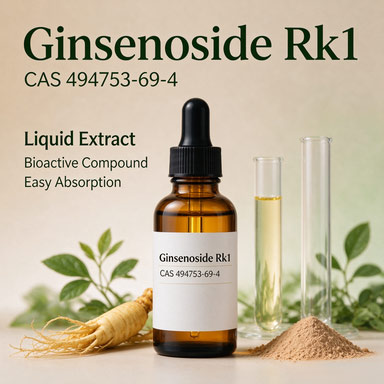
Ginsenoside Rk1 (CAS 494753-69-4) belongs to the dammarane family of triterpene saponins, a class of naturally occurring compounds that researchers find across ginseng species. Chemists also call this molecule Ginsenoside RK1. It carries the molecular formula C42H70O12 and a molecular weight of 767.00 g/mol, and its exact mass measures 766.4868. Moreover, scientists obtain Ginsenoside Rk1 from heat-processed Panax ginseng C.A.Mey., a material that they often call red ginseng root. Because two double bonds at positions 20(21) and 24 shape its dammarane skeleton, this rare saponin draws steady attention from natural-product chemists and screening laboratories. Furthermore, its InChIKey KWDWBAISZWOAHD-MHOSXIPRSA-N gives analysts a precise identifier for database searches and identity confirmation.
Quality You Can Verify
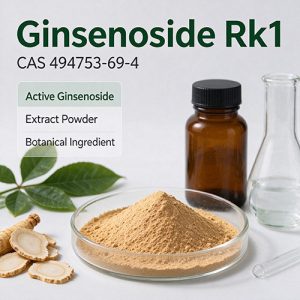
Shaanxi Baisifu Biological Engineering Co., Ltd. produces Ginsenoside Rk1 under strict quality control. Consequently, every batch reaches HPLC purity of 98% or higher and arrives as a white-to-off-white powder. In addition, each shipment carries a Certificate of Analysis, an HPLC chromatogram, and NMR spectra. Therefore, your team can confirm identity and purity before any experiment starts. Furthermore, the powder dissolves in water, hot methanol, and ethanol, so researchers can prepare working solutions with common lab solvents. Because the compound loses purity after prolonged air exposure, our analysts pack each lot in amber glass under desiccant and seal it quickly.
Research Applications
First, analytical chemists keep Ginsenoside Rk1 as a reference standard for content determination, identity confirmation, and HPLC method validation in ginseng preparations. Moreover, they apply it to quantization in traditional medicine formulas and plasma sample analysis. Second, natural-product chemists study its formation during the heat processing of ginseng, and they explore structure–activity relationships around the distinctive 20(21) double bond. Third, cell biology groups examine cellular responses in controlled in vitro models and measure signaling markers across dose ranges. As a result, the saponin supports studies of cellular stress responses. Finally, synthetic chemists use Ginsenoside Rk1 as a scaffold for derivatization work on the sugar groups or the dammarane skeleton. Taken together, these applications support academic research, pharmaceutical R&D, and natural-product chemistry.
Need specifications, COA, or a wholesale quote? Contact Us — typical response within 24 hours.