Ginsenoside Rh3 Powder98% HPLC CAS105558-26-7
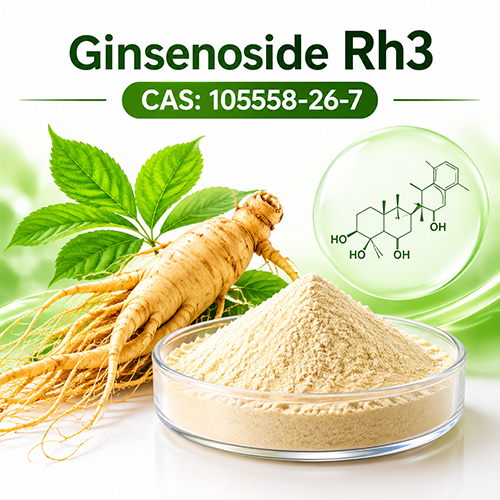
Ginsenoside Rh3 Powder – 98% HPLC Rare Ginseng Saponin
Ginsenoside Rh3 is a rare protopanaxadiol-type saponin from Panax ginseng, and our factory supplies it as an HPLC-verified white powder at 90%, 95% and 98% purity. Each lot leaves the warehouse with a chromatogram, MS and NMR data and a complete document pack, so formulators work with one declared molecule instead of a variable ginseng extract.
What ginsenoside Rh3 is. Ginsenoside Rh3 carries CAS number 105558-26-7, the molecular formula C36H60O7 and a molecular weight of 604.86 g/mol. The molecule belongs to the protopanaxadiol family and holds a single glucose unit at C-3, which makes it one of the more lipophilic ginsenosides. Fresh ginseng root contains almost none of it, because Rh3 forms mainly when ginsenoside Rg5 loses water during steaming, drying or enzymatic conversion. Manufacturers therefore produce commercial Rh3 through directed biotransformation or semi-synthesis, and buyers use the purified material in supplements, skin care and laboratory work.
Key features. HPLC-UV at 203 nm quantifies Rh3 against a certified reference standard, and we attach the chromatogram to every COA. MS and NMR data accompany each lot, so your QC team checks structure as well as purity. Heavy metals by ICP-MS, residual solvents by GC and a full microbiological panel stay within pharmacopoeial limits. We mill to 80, 100 or 200 mesh, adjust assay between 90% and 98%, and blend with Rh2, Rg3, Rk1, Rg5 or Compound K. Finally, we record the ginseng batch, the conversion run and the purification lot, so a question about one drum resolves without guesswork.
Applications and uses. Supplement brands build rare-ginsenoside formulas around Rh2, Rg3, Rk1 and Rh3, because each compound carries its own research file. Rh3 disperses evenly in powder blends at low inclusion rates; as a result, one kilogram of 98% material supports thousands of capsules. Formulators combine it with microcrystalline cellulose or rice powder, then fill hard capsules or stick sachets. Because the molecule shows limited water solubility, drink mixes work better with a phospholipid complex, a cyclodextrin inclusion or an emulsified oil phase.
Cosmetic chemists add Rh3 for its antioxidant and tone-evening research profile. It dissolves in the oil phase or a glycol pre-mix, so it fits emulsions, anhydrous balms and alcohol-based ampoules. Therefore manufacturers dose it below 45 °C to preserve the glycosidic bond, and bench trials usually run between 0.05% and 0.5%. We supply cosmetic-grade lots with the heavy-metal and microbial data that a safety assessor needs for the product information file.
Academic and contract laboratories use Rh3 as a tool compound. Published work examines Nrf2-mediated antioxidant signalling, NF-κB and MAPK inflammatory cascades, insulin sensitivity in hepatic and muscle cell models, and neuronal survival under oxidative stress. These programs need identity and a paper trail rather than volume, so we offer 20 mg and 50 mg vials with full spectral data.
Quality laboratories quantify rare ginsenosides in red ginseng, black ginseng and finished supplements, and they need a trustworthy calibration point. Rh3 at 98% serves that role in HPLC-UV and LC-MS methods. Furthermore, the same standard supports method validation and adulteration screening, because a spiked sample reveals whether a supplier actually added rare saponins.
Developers work with Rh3 in shots, instant powders and gummies. Pasteurisation heat stays modest, and the molecule keeps its profile across a typical shelf life when the formula holds a pH between 4 and 7. At the same time, bitterness control matters, so masking agents, a fruit-acid base or an encapsulation step keeps the sensory panel happy.
We blend Rh3 with Rh2, Rg3, Rk1, Rg5 or Compound K at agreed ratios, mill to your target particle size and pack under your brand. Moreover, our ISO 9001 system covers the blended product as well as the single compound, so your quality team reviews one supplier instead of three.
Quality control and documents. Our QC laboratory tests each lot before release, and no shipment leaves without a signed COA. The document pack covers the specification sheet, the HPLC chromatogram, the mass spectrum, the safety data sheet, and declarations on allergens, GMO status, irradiation and country of origin. In addition, we welcome third-party testing: many buyers send samples to SGS, Eurofins or their own contract laboratory before approving a supplier, and we support that step with retention samples from the same lot.
Packaging and delivery. Reference vials travel in amber glass at 2–8 °C. Bulk powder ships in 25 kg fibre drums with double food-grade LDPE liners, and it keeps below 25 °C in a dry, dark store because the material is hygroscopic and light-sensitive. Stock lots leave our warehouse within 3–7 business days by DHL, FedEx or UPS door to door; air freight suits 25–100 kg and sea freight carries pallet quantities. We prepare the commercial invoice, packing list, certificate of origin and, where a market requires it, the health certificate.
FAQ
Q: What is your MOQ? A: Reference vials start at 20 mg, trial orders at 100 g, and bulk pricing starts at 1 kg. Production orders ship in 25 kg drums.
Q: Can I get a free sample? A: Yes. We send 10–50 g free of charge to qualified buyers, and you cover the freight only.
Q: Which documents do you provide? A: A lot-specific COA with chromatogram, specification sheet, SDS, MS and NMR data, plus allergen, GMO, non-irradiation and origin declarations on request.
Q: How do you verify purity? A: We assay every lot by HPLC against a certified reference standard and confirm identity by MS and NMR. You receive the raw data, not just a number.
Q: Does it dissolve in water? A: Only partly. It dissolves in methanol, ethanol and DMSO, so beverage developers use ethanol pre-dissolution, cyclodextrin inclusion or an emulsion.
Q: Do you support OEM and private label? A: Yes. We blend to your ratio, mill to your mesh size and pack under your brand, and we issue a COA for the blend as well as for each component.
Need specifications, COA, or a wholesale quote? Contact Us — typical response within 24 hours.