Siberian Ginseng Extract Eleutherococcus senticosus · Root & Rhizome
Eleutherococcus senticosus · Root & Rhizome
Baisifu supplies Siberian Ginseng Extract with a clear Latin identity and documented specifications. Our team publishes the botanical source, extract ratio, and marker-compound data for every lot, and we include a Certificate of Analysis plus an MSDS with each shipment. Buyers gain a traceable botanical raw material instead of an ambiguous herb powder.
What Siberian Ginseng Extract Actually Is
Siberian ginseng refers to a woody shrub native to parts of Northeast Asia, and botanists classify it as Eleutherococcus senticosus. Many suppliers also list the synonym Acanthopanax senticosus or the common name ciwujia. Notably, this plant differs from true ginseng, which belongs to the genus Panax. Consequently, buyers who need botanical accuracy check the Latin name on the specification sheet rather than relying on the word “ginseng” alone.
The extract draws from the root and rhizome, where growers and processors find the characteristic marker compounds eleutheroside B and eleutheroside E. During production, our team selects raw botanical material, controls the extraction ratio, and documents the resulting profile. Moreover, the powder dissolves in water and ethanol, so formulators incorporate it into both dry blends and liquid systems with ease. In addition, its brown to yellowish-brown color and fine particle size support uniform mixing across a batch.
Where Siberian Ginseng Extract Fits Your Workflow
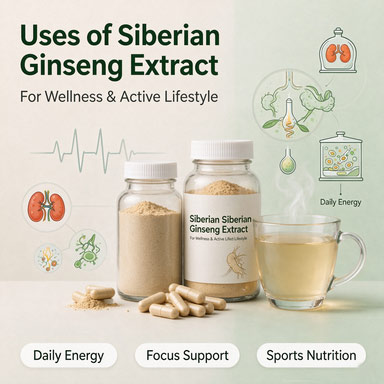
Furthermore, customers apply this botanical extract across several distinct workflows. Each use relies on the same core advantage: a documented botanical identity, a defined extract ratio, and a reproducible analytical profile.
Botanical Research
Research teams study the extract as a defined plant material. Specifically, they use the marker-compound profile to compare batches and to document the identity of their starting material.
Food & Beverage Development
Product developers incorporate the powder into botanical drink concepts, blended powders, and recipe trials. Meanwhile, each team checks the ingredient rules of its target market.
Cosmetic Formulation
Formulators evaluate the extract in experimental systems as a plant-derived component. In particular, they test color, compatibility, and stability within their own prototype batches.
Dietary Supplement Manufacturing
Manufacturers add the extract to capsule, tablet, and blended powder formats as a standardized botanical component. Therefore, each producer applies the labeling rules of its own market.
Feed Studies
Animal nutrition researchers explore the material in controlled feed trials as a botanical additive. Equally important, they record inclusion rates and observe palatability in their own study designs.
Analytical Identity Work
Laboratories examine the extract to confirm botanical identity and to characterize the marker-compound profile. As a result, your quality team gains defensible data for incoming material checks.
On the other hand, buyers should treat this material as a raw ingredient rather than a finished consumer product. We do not attach performance promises to it. Taken together, these boundaries support clear communication between supplier and buyer.
Specification Sheet
Beyond that, transparent data shortens your qualification cycle. Every field below describes the material itself, not an outcome.
| Item | Detail |
|---|---|
| Product name | Siberian Ginseng Extract |
| Latin name | Eleutherococcus senticosus (Rupr. & Maxim.) Maxim. |
| Synonym | Acanthopanax senticosus; ciwujia |
| Plant family | Araliaceae |
| Plant part | Root and rhizome |
| Common specifications | Extract ratios such as 4:1, 10:1 and 20:1; versions standardized for eleutheroside content |
| Marker compounds | Eleutheroside B (syringin) and eleutheroside E |
| Appearance | Brown to yellowish-brown fine powder |
| Solubility | Soluble in water and ethanol |
| Grade | Food grade / cosmetic raw material / research grade |
| Documentation | Certificate of Analysis, MSDS, chromatographic profile on request |
| Exact assay figures | Stated on the batch Certificate of Analysis |
| Packaging | Sealed foil bag, with custom packing available on request |
| Storage | Keep the sealed container in a cool, dry area away from direct light and strong odors |
| Shelf life | 24 months when you keep the material in the recommended conditions |
How We Control Every Batch
Botanical traceability
Naturally, traceability starts at the plant. We document the Latin name, the plant part, and the extraction route, and we link each batch to its own analytical record. In this way, your purchasing team receives a full paper trail that supports internal audits and identity checks.
Analytical transparency
Consequently, our quality team analyzes every production lot before release. The resulting Certificate of Analysis lists the extract ratio, marker-compound data, moisture, and appearance in plain figures. Likewise, we provide an MSDS so your safety officers complete their assessments without delay. Should you need the original chromatogram, our technical staff can send it on request.
About the supplier
Baisifu operates as a botanical ingredient supplier under Shaanxi Baisifu Biological Engineering Co., Ltd. We focus on plant extracts, saponin monomers, and fine chemical raw materials. Rather than relying on vague descriptions, we publish exact Latin names, extract ratios, and analytical specifications for every item. Therefore, procurement teams compare offers on a like-for-like basis and qualify a supplier with clear documentation.
Tell us the specification, quantity, and destination market you need. Our team will reply with pricing, lead time, and the full document pack, so you can move from inquiry to qualification without delay.
Official site: www.baisfubio.com
Need specifications, COA, or a wholesale quote? Contact Us — typical response within 24 hours.