Ginsenoside Compound K Supply | CAS 39262-14-1 | 98% HPLC
PRODUCT INTRODUCTION
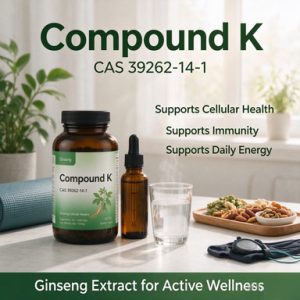 Botanical Ingredient Supplier Expands Rare Ginsenoside Compound K (CAS 39262-14-1) Supply for Global Formulators
ISO 9001-certified supplier of rare ginsenosides and botanical actives, today announced expanded supply of Ginsenoside Compound K (CAS 39262-14-1). The company now offers 98% HPLC-verified CK powder in bulk, and it ships to cosmetic, nutrition, and food manufacturers worldwide. Moreover, the expansion answers growing demand from formulators who want a standardized, well-documented source of this scarce saponin.
A Regulatory Milestone Raises Industry Attention
Compound K has moved from a laboratory subject to a recognized cosmetic ingredient. China’s National Medical Products Administration recorded “Ginsenoside Compound K” as a new cosmetic ingredient in May 2025 (record No. 20250059), and this listing made it the first ginsenoside to clear that regulatory pathway. Furthermore, industry organizations published two supporting standards — T/GAIA 028-2025 for HPLC content determination and T/FDSA 0098-2025 for the cosmetic raw material — so buyers now have formal methods to verify purity. Consequently, procurement teams can specify Compound K with far greater confidence than before.
Market data reinforces that momentum. A 2025 industry report put China’s ginseng-based cosmetics market at roughly RMB 11.6 billion in 2024. In addition, a Verified Market Research analysis projects the global ginseng extract market to grow from USD 31.28 million in 2023 to USD 50.99 million by 2031, which reflects a compound annual growth rate of 6.4%. As a result, ingredient suppliers who combine bioconversion expertise with rigorous documentation stand out in a crowded field.
Why Compound K Needs Bioconversion
Chemically, Compound K is a rare protopanaxadiol-type saponin with the molecular formula C36H62O8 and a molecular weight of 622.87 g/mol. It carries a single glucose molecule, and this compact structure gives it better membrane permeability than common precursor ginsenosides such as Rb1. However, raw ginseng root holds CK only in trace amounts, so manufacturers cannot extract it economically at scale. Instead, producers create it through enzymatic or microbial bioconversion, which cleaves sugar groups from precursor saponins such as Rb1, Rb2, and Rc. Therefore, process control matters as much as the botanical source. Equally important, our ISO 9001 facility runs every lot through HPLC testing, and we attach a lot-specific Certificate of Analysis to each shipment.
Need a weight-management ingredient partner?
COA, samples and RFQ quotations — reply within one business day.