
Ginsenoside Rf Powder — CAS 52286-58-5, ≥98% HPLC, Bulk Supply
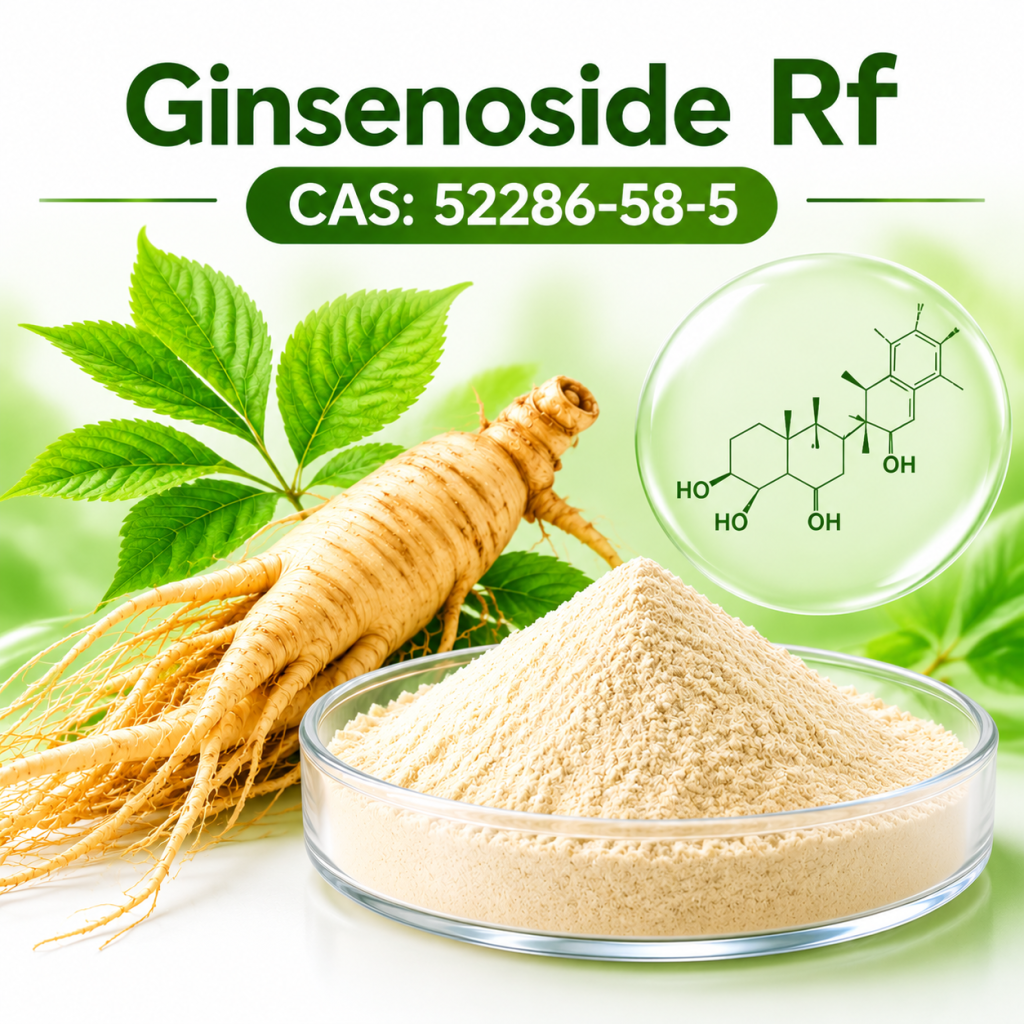
Ginsenoside Rf gives quality teams a single, well-defined protopanaxatriol saponin instead of a shifting ginseng extract. Our ISO 9001 facility supplies HPLC-verified Rf powder from 20 mg reference vials up to 25 kg drums, and every lot arrives with a chromatogram, MS and NMR data and a complete document pack. Laboratories use the compound as an analytical reference standard, supplement brands use it to standardise ginseng products, and cosmetic chemists add it to pore-care and skin-tone formulas.
Short answer: what is ginsenoside Rf?
Ginsenoside Rf is a dammarane-type triterpenoid saponin from Panax ginseng C. A. Mey. It carries CAS number 52286-58-5, the molecular formula C₄₂H₇₂O₁₄ and a molecular weight of 801.01 g/mol. The molecule belongs to the protopanaxatriol (PPT) family and holds a disaccharide chain of two glucose units at C-6. It appears as a white powder, melts at 197–198 °C, and dissolves readily in water, methanol and ethanol while it stays poorly soluble in chloroform, ether and benzene. Fresh ginseng root contains only trace amounts, because Rf sits far below major saponins such as Rb1 and Rg1 in the natural profile.
Why ginsenoside Rf is difficult to source
Nature keeps Rf at low levels. Different cultivation regions, root ages and plant parts change the Rf content sharply, and the compound often hides next to its structural neighbour Rg1, which shares a similar polarity and retention behaviour. Consequently, a conventional resin column alone cannot deliver high-purity Rf. Manufacturers therefore combine macroporous resin enrichment with silica gel and ODS column work, and preparative HPLC provides the final polish. In addition, biotransformation offers a second route: microbial or enzymatic systems convert abundant saponins such as Rg1 into Rf, and that strategy reduces the pressure on scarce root material. Both routes demand analytical control, so a buyer should qualify the supplier’s HPLC method before committing to a volume.
Buyers also confuse Rf with its neighbours. Ginsenoside Rg1 carries one glucose unit at C-6 and one at C-20 and shows a lower molecular weight; Rf adds a second glucose at C-6 and reaches 801.01 g/mol; Re carries a rhamnose in the sugar chain. Therefore an HPLC gradient that resolves Rf, Rg1 and Re on one chromatogram matters more than a label claim, and we run a validated method against certified reference standards so your QC team can compare retention times directly.
Specification
| Parameter | Specification |
|---|---|
| Appearance | White to off-white fine powder |
| Identification | Conforms to reference standard by HPLC, MS and NMR |
| Assay (HPLC-UV, 203 nm) | 90% / 95% / 98% |
| Melting point | 197–198 °C |
| Loss on drying | ≤ 3.0% |
| Residue on ignition | ≤ 0.5% |
| Heavy metals (ICP-MS) | Pb ≤ 2 ppm; As ≤ 1 ppm; Cd ≤ 1 ppm; Hg ≤ 0.1 ppm |
| Residual solvents (GC) | Within ICH Q3C limits |
| Microbiology | TPC ≤ 1,000 cfu/g; yeast and mould ≤ 100 cfu/g; E. coli and Salmonella absent |
| Particle size | 80 mesh standard; 100 or 200 mesh on request |
| Packaging | 20 mg–1 g vials; 100 g–1 kg foil bags; 25 kg fibre drums |
| Shelf life | 24 months in unopened packaging |
Applications and uses
Analytical reference standard. Quality laboratories quantify ginsenosides in red ginseng, black ginseng, American ginseng and finished supplements, and they need a trustworthy calibration point for each compound. Rf at 98% serves that role in HPLC-UV, LC-MS and TLC methods. Furthermore, the same standard supports method validation, stability studies and adulteration screening, because a spiked sample reveals whether a supplier actually added a defined saponin or simply relabelled an ordinary extract.
Dietary supplement standardisation. Supplement brands standardise ginseng extracts against a full saponin panel, and Rf forms part of that panel in Asian ginseng monographs and internal specifications. Formulators blend trace Rf into rare-ginsenoside complexes together with Rg3, Rk1, Rh2 and Compound K, and they dose it at low inclusion rates in capsules and stick sachets. Because the molecule dissolves in water and ethanol more readily than many PPD-type saponins, beverage developers can work with direct dissolution or a simple glycol pre-mix.
Skin care and cosmetics. Cosmetic chemists value Rf for its antioxidant and barrier-support research profile. Patent literature describes Rf-containing skin compositions for pore-care, sebum control and skin-tone applications, and a recent peer-reviewed cell study reported that Rf lowered intracellular ROS and pro-inflammatory cytokines while it supported barrier proteins such as filaggrin and aquaporin-3 in stressed skin cells. The compound dissolves in the water phase or a glycol pre-mix, so it fits emulsions, toners and ampoules alike. Manufacturers therefore dose it in the cool-down phase below 45 °C, and bench trials typically run between 0.05% and 0.5%.
Pharmaceutical research. Academic and contract laboratories use Rf as a tool compound. Published work examines N-type voltage-gated calcium channel modulation in sensory neurons, neuroprotection in amyloid and glutamate-stressed cell models, and central-nervous-system activity in rodent studies. These programs need identity, purity and a paper trail rather than volume, so we offer 20 mg and 50 mg vials with full MS and NMR data.
Functional food and beverages. Developers work with Rf in instant powders, shots and gummies. Because the molecule tolerates water-based systems, formula work moves faster than with lipophilic saponins, and a pH window between 4 and 7 keeps the profile stable across a typical shelf life. At the same time, bitterness control matters, so masking agents or an encapsulation step keeps the sensory panel happy.
Custom development. We blend Rf with Rg1, Re, Rg3, Rk1 or Compound K at agreed ratios, mill to your target particle size and pack under your brand. Moreover, our ISO 9001 system covers the blended product as well as the single compound, so your quality team reviews one supplier instead of three.
Quality and documentation
Our QC laboratory tests each lot before release, and no shipment leaves without a signed COA. The document pack includes the specification sheet, the HPLC chromatogram, the mass spectrum, the safety data sheet, and declarations covering allergens, GMO status, irradiation and country of origin. In addition, we welcome third-party testing: many buyers send samples to SGS, Eurofins or their own contract laboratory before approving a supplier, and we support that step with retention samples from the same lot. Traceability runs backwards to the raw herb, because we record the ginseng batch, the purification run and the release data, so a question about one drum resolves without guesswork.
Packaging, storage and shipping
Reference vials stay at 2–8 °C. Bulk powder keeps below 25 °C in a dry, dark store, and the container stays sealed because the material absorbs moisture. Under those conditions the shelf life reaches 24 months from the production date. Stock lots leave our warehouse within 3–7 business days, express couriers deliver door to door in about a week, air freight suits 25–100 kg, and sea freight carries pallet quantities. We prepare the commercial invoice, packing list, certificate of origin and, where a market requires it, the health certificate.
Frequently asked questions
What is ginsenoside Rf used for? Laboratories use ginsenoside Rf as an HPLC and LC-MS reference standard, supplement brands use it to standardise ginseng extracts, and cosmetic chemists add it to pore-care and skin-tone formulas.
What is the CAS number and molecular formula? Ginsenoside Rf carries CAS number 52286-58-5, the molecular formula C₄₂H₇₂O₁₄ and a molecular weight of 801.01 g/mol. It belongs to the protopanaxatriol group of dammarane saponins.
How does Rf differ from Rg1 and Re? All three share a protopanaxatriol backbone. Rg1 carries single glucose units at C-6 and C-20, Rf adds a second glucose at C-6 and reaches 801.01 g/mol, and Re carries a rhamnose in its sugar chain. A suitable HPLC gradient resolves all three peaks.
Which purity grades do you supply? We stock 90%, 95% and 98% HPLC grades. Reference vials start at 20 mg, sample bags from 100 g, and production orders ship in 25 kg drums. We also mill to 100 or 200 mesh and blend to custom ratios.
What is the MOQ and lead time? Reference quantities begin at 20 mg and trial orders at 100 g. Stock lots ship in 3–7 business days; custom purity, mesh or blend orders take 10–15 business days, and bulk pricing starts at 1 kg.
Does ginsenoside Rf dissolve in water? Yes, readily. The compound dissolves in water, methanol and ethanol, while it stays poorly soluble in chloroform, ether and benzene. That solubility profile simplifies beverage and tonic formulation work.
Which documents arrive with each lot? Every shipment includes a lot-specific COA with the HPLC chromatogram, a specification sheet, a safety data sheet and MS/NMR identity data. On request we add allergen, GMO, non-irradiation and country-of-origin declarations plus the ISO 9001 certificate.
Do you ship worldwide? We ship to more than 60 countries. Express couriers handle samples and small orders, air freight covers 25–100 kg, and sea freight moves pallet quantities.
Need specifications, COA, or a wholesale quote? Contact Us — typical response within 24 hours.